



THE ART OF
BEING LOCAL
IN MALTA
Starting a Business in Malta
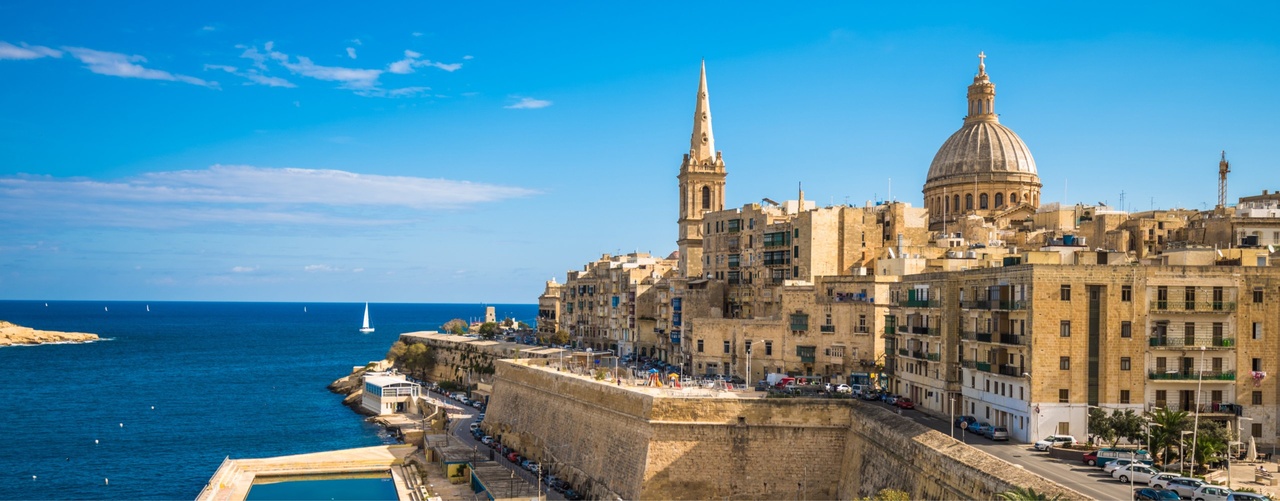
Starting a business in Malta gives international companies a base inside the EU single market where English is both an official and a working language. InterGest Malta guides foreign companies through it from Valletta.
What you need to know about starting a business in Malta
Almost every company is set up as a private limited company, in short Ltd, for trading as well as for holding purposes. Share capital starts at €1,164.69, of which at least 20 % has to be paid up on registration. Registration takes two to three working days once we file the documents. Preparation before that takes longer. Corporate income tax is 35 % on paper, and the Maltese refund system brings the effective burden down considerably, depending on the case. You never have to appear in person.
Interested in other countries where InterGest is present? You will find more on our overview page starting a business abroad, including a comparison table of the most common legal forms and regional overviews, for example on starting a business in Germany, in Hungary, France or China.
An overview of all InterGest services is on our services page.
Your contacts for starting a business in Malta
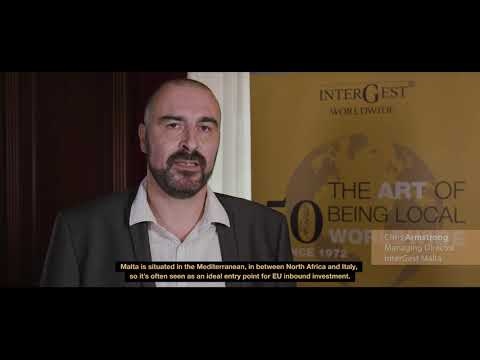
Chris Armstrong, director of InterGest Malta, looks after accounting, audit and fiduciary structures. He is a member of the Association of Chartered Certified Accountants (ACCA), the Institute of Financial Services Practitioners (IFSP) and the Society of Trust and Estate Practitioners (STEP), and also holds qualifications in trusts and foundations.

Thomas Jacobsen, also a director, covers the tax and legal side. A lawyer from the University of Oslo specialising in international tax, he moved to Malta in 1997 and spent ten years in the tax and legal department of PwC. In 2007 he co-founded a multi-disciplinary boutique advising on cross-border compliance and tax matters. He is a member of the Malta Institute of Taxation (MIT), the IFSP, the International Bar Association (IBA), the International Fiscal Association (IFA) and STEP.

Szabolcs Toth is commercial manager and your first point of contact. An economist with a postgraduate degree in foreign trade, he has run business operations across Europe, the Middle East and South Asia, with assignments in Africa in oil and gas and in fintech. He has lived in Malta since 2012 and worked there in ICT and in corporate services. As an expat himself, he knows the questions foreign clients ask.


What are the advantages of starting a business in Malta?
One reason outweighs the rest: Malta is the only EU country where English is an official language. Contracts and correspondence with the authorities run in English, without certified translations. Five further points come on top, and their weight depends on your business model:
- EU single market: Malta has been an EU member since 2004, in the euro area since 2008 and in the Schengen area since 2007. A Maltese company trades inside the EU without customs borders.
- Tax system: 35 % corporate income tax on paper, combined with a refund system for shareholders. How much of it arrives depends on the type of income and on the structure.
- Employment costs: The employer social security contribution is 10 %, capped at €55.93 per week in 2026, plus 0.30 % for the maternity fund. Above roughly €29,000 of annual salary the contributions stop rising.
- Location: In the middle of the Mediterranean between Europe and North Africa, with direct flights to most European business centres.
- Talent: An English-speaking workforce and a services sector grown over decades around finance, ICT and gaming.
One caveat belongs with all of this: the advantages only hold if the company genuinely sits in Malta. Without an office, without staff and without decisions taken on the island, management and control are hard to place there, and a letterbox arrangement survives no review. Building that substance is where InterGest Malta comes in.
Which legal form is right for starting a business in Malta?
Companies that set up a company in Malta almost always choose the private limited company. It carries the suffix Ltd or Limited, liability is limited to the company assets, and shareholders are liable only up to their contribution. Trading operations and holding structures use the same vehicle.
An Ltd needs one director as a minimum and a company secretary without exception. Shareholders, directors and the secretary may all be foreign, and no residence requirement applies. The Companies Act asks for two shareholders in principle but allows a single member company under article 212. In a private exempt company, the sole director may also serve as company secretary. Anyone who wants to start a company in Malta therefore needs neither a local partner nor a Maltese managing director, though a traceable connection to the island is required.
Maltese law also knows the public limited company with €46,587.47 minimum capital for capital market projects, the branch of a foreign company, where the parent is directly liable, and partnerships. For the classic subsidiary of a mid-sized company, the Ltd remains the usual route.
| Legal form | Liability | Typical use | Suitability for foreign investors |
|---|---|---|---|
| Private limited company (Ltd) | Limited to the company assets | Subsidiary, sales, holding | Very suitable, the standard case |
| Public limited company (plc) | Limited | Capital market projects, €46,587.47 minimum capital | Only for larger structures |
| Branch | Parent company is directly liable | Dependent presence without a separate entity | Only for special cases |
| Partnership | Up to unlimited, depending on the form | Small local projects, joint ventures | Rarely chosen |
Advantage: The Ltd gives the parent full control and a clear structure of shareholders, directors and company secretary. It can hire staff, sign contracts and acquire property.
Ongoing duties: Shareholders approve the annual accounts within 10 months of the financial year end, and the company files them a further 42 days later. The return for the company tax Malta levies falls due 9 months after the year end. On top comes the annual return to the Maltese company register.
Audit: Here Malta departs from most EU states. Only companies below two of three limits escape the audit: €46,600 total assets, €93,000 turnover and 2 employees on average. A subsidiary passes those marks almost always, so it needs audited accounts every year.
Location and infrastructure in Malta
When setting up a business in Malta, the location question is rarely decided by distance. Distances are short: a few kilometres separate the harbour from the airport. These criteria are decisive:
- Registered office: Valletta and the harbour towns around it are the administrative and financial centre. What counts for a company seat is being close to authorities, banks and advisors.
- Substance: An office of your own, local staff and decisions actually taken in Malta are not a formality. They are the basis on which the company counts as Maltese for tax purposes.
- Talent: Wages are below western European levels, and the statutory minimum wage is €229.44 per week in 2026, or €5.74 an hour. For specialised profiles, however, you compete with finance and gaming companies.
- Logistics: The freeport at Marsaxlokk is one of the largest transhipment hubs in the Mediterranean. That helps goods flows into the EU, less so warehousing on the island itself.
- Sector: What the best business to start in Malta is depends above all on the licence it needs. Financial services, insurance and gaming require one from the regulator MFSA or from the Malta Gaming Authority. Expect that to extend the timeline considerably.
InterGest Malta is based in Valletta, in St Christopher Street, a few minutes on foot from the authorities and the banks of the capital.


What steps does starting a business in Malta involve?
Seven steps stand between the first decision and a Maltese Ltd on the register:
- Secure the company name: The registry checks the preferred name for availability and reserves it. Two alternatives in reserve save a waiting loop.
- Settle the structure: Shareholders, at least one director, the company secretary and the registered office in Malta all have to be decided, along with the level of share capital.
- Word the objects clause: The planned activity goes into the articles verbatim. It decides whether a licence applies and how VAT treats the business.
- Draw up the articles: Memorandum and articles of association are prepared and signed by every shareholder.
- Pay in the capital: At least 20 % of the subscribed capital goes into an account, so roughly €233 at the minimum capital of €1,164.69. The bank issues a confirmation.
- Certify the documents: Certified copies of passports, CVs and evidence of source of funds have to exist as originals. In practice this step sets the timeline.
- File the application: The complete application goes to the registry electronically. Registration follows within two to three working days, and the certificate of incorporation arrives with it.
Registration creates the company but does not yet make it operational. Next come the tax number, VAT registration where it applies, registration as an employer and the business account. None of these steps calls for a personal appearance, though the certified originals do have to travel to Malta.
InterGest Malta can take these steps off your hands or make them simpler, from the name reservation to the tax number, and keeps an eye on the deadlines.
What does starting a business in Malta cost and how long does it take?
Formation costs start at €1,750 plus VAT. Included are advice, due diligence, the articles and the filing with the registry. On top comes the state registration fee: with authorised capital up to €1,500 that is €100 for an electronic filing; the fee rises with the capital and is capped at €1,900. Since March 2025 electronic filing is the only route.
| Item | Duration |
|---|---|
| Initial call, proposal and structure | A few days |
| Obtaining and filing the certified documents | Depends on your preparation |
| Due diligence and onboarding | A few days to 2 weeks |
| Drawing up memorandum and articles of association | A few days |
| Registration with the registry | 2 to 3 working days |
| Tax number and VAT registration | Following registration |
| Opening the business account | Several weeks, depending on the provider |
Share capital: The minimum authorised capital of an Ltd is €1,164.69. At least 20 % of it must be paid up, around €233. In practice we recommend at least €1,200, because banks and business partners look at it.
Ongoing taxes: Malta corporate income tax is 35 %. Once the company pays a dividend, shareholders can claim part of it back: 6/7 in the standard case, which brings the burden down to roughly 5 %, 5/7 on passive interest and royalties, which works out at about 10 %, and 2/3 where the company has already claimed credit for foreign tax, about 11.67 %. Profits from a qualifying participating holding can carry a full 100 % refund. The refund goes to the shareholder, not to the company, and that shareholder has to register with the tax authority first. VAT in Malta, officially value added tax (VAT), carries a standard rate of 18 %, with reduced rates of 12, 7, 5 and 0 % for certain supplies. Registration becomes mandatory above €35,000 of annual turnover, and separately for anyone making intra-EU acquisitions of more than €10,000 a year.
Withholding tax: Malta levies 0 % withholding tax on dividends, interest and royalties paid to recipients abroad. The 2001 double taxation treaty with Germany provides for 5 % on dividends from a 10 % shareholding and 15 % otherwise, but expressly switches those rates off for Malta while the imputation system applies.
Deadlines: The tax return falls due 9 months after the financial year end, and the authority extends that date each year by notice for electronic filers. File the annual accounts late and the penalty can reach €2,329 plus €46 for every further day.
Note: The actual burden depends on the type of income, the shareholder structure and the double taxation treaty. For German parent companies the treaty adds an activity condition: without evidence of an active trade, Germany credits the Maltese tax instead of exempting it. Clarify that before the formation, not after.

Which documents do I need for starting a business in Malta?
To create a company in Malta you need surprisingly few papers. What takes time is not their number but their form. Malta wants certified originals, and those have a lead time.
For the company:
- Company name, three proposals for reservation
- A precise description of the planned activity
- Details of capital, shares and registered office
- Memorandum and articles of association
For shareholders and officers:
- Certified copies of passports, as originals
- An up to date CV
- Bank statements as evidence of source of funds
- For non-EU nationals, a bank or professional reference letter in addition
- Where a body corporate is a shareholder: documents covering the whole ownership chain up to the ultimate beneficial owners
At the end of the registration stands the certificate of incorporation Malta issues, the official proof that the company exists. Registration alone is not the end of it. Next come the tax number, VAT registration, registration as an employer and, depending on the sector, a licence. You will find answers to common questions in our FAQs.
Which legal aspects apply when starting a business in Malta?
Most of it goes back to one statute, the Companies Act, chapter 386 of the laws of Malta. It regulates formation, corporate bodies, capital and liability, and sets the minimum capital of an Ltd at €1,164.69. Malta incorporation runs through the Malta Business Registry, in short MBR. The Maltese business register it keeps later holds the annual accounts and the annual return as well.
Tax matters sit with the Malta Tax and Customs Administration (MTCA), the successor of the Commissioner for Revenue (CfR). It issues the tax number, keeps the VAT register and handles the refunds to shareholders. Anyone hiring staff registers every engagement with Jobsplus, no later than four working days after it starts. Financial service providers and insurers additionally need a licence from the regulator MFSA.
These authorities and legal foundations accompany every company formation in Malta:
| Legal basis / authority | Function |
|---|---|
| Companies Act (chapter 386) | Governs formation, corporate bodies, capital and liability of Maltese companies. |
| Malta Business Registry (MBR) | Keeps the company register, registers companies, issues the certificate of incorporation and receives the annual return. |
| Malta Tax and Customs Administration | Issues the tax number, levies corporate income tax and handles the refunds to shareholders. |
| Value Added Tax Act | Governs VAT: 18 % standard rate, registration mandatory above €35,000 of annual turnover. |
| Jobsplus | Receives the registration of every employment relationship, within four working days. |
| MFSA | The financial services regulator, licensing authority for regulated activities. |
| Industrial Property Registrations Directorate | Keeps the national trademark register, base fee €115 per class. |
What financing options are there for starting a business in Malta?
Parent companies typically finance a Malta company setup from a mix of several sources:
- Equity from the home country: The standard route. Beyond the minimum capital, a reserve for the operating costs of the first months belongs in the plan, because opening an account takes time.
- Shareholder loans: Loans from the parent company are common. Document the contract and the market-rate interest, otherwise the tax authority may not recognise interest and repayment.
- Local bank loans: Maltese banks look very closely at new companies with foreign owners. In the start-up phase, equity remains the more reliable route.
- Venture capital: Venture capital and business angels exist in Malta too, but the market is small. For the classic subsidiary of a mid-sized company they rarely play a role.
- Grant schemes: Through its Business Development measure, Malta Enterprise covers up to 75 % of eligible costs, capped at €300,000 over three years. Start-ups can apply instead for a repayable advance of up to €500,000. The scheme excludes trade, gaming and financial services.
Which structure fits depends on the sector, the capital requirement and the pace; usually it is equity plus a shareholder loan. InterGest Malta reviews the capital structure as a whole and makes sure it does not unnecessarily complicate a later distribution and the tax refund.
Certified documents arranged too late
Malta requires certified copies of passports as originals, sent by courier. Anyone who only visits a notary after the first call easily loses two weeks, while the registration itself takes two to three working days.
InterGest tells you right at the start which documents you need and in what form.
Business activity described too vaguely
The planned activity goes into the articles and determines permits, VAT treatment and the bank account. A catch-all formula such as trade and consultancy triggers queries and delays everything that follows.
We word the objects clause so that it covers your business and still stands up to review.
VAT obligations underestimated
Whether you have to register, how you invoice and what you report depends on the actual activity and on the place of supply. Since January 2025 a single threshold of €35,000 applies, where different values for goods and services applied before.
We clarify the registration before your first invoice and then take over the ongoing filings.
FREE BOOK BY PETER ANTERIST
The 11 most expensive mistakes when starting a business abroad
Peter Anterist, CEO of InterGest Worldwide GmbH, has distilled the experience of more than 50 years of international company formation practice and projects in 50+ countries into a book: Fail in Foreign Trade. 11 typical pitfalls when starting a business abroad, from bogus self-employment and transfer pricing to compliance, and how international companies avoid them.


What InterGest in Malta handles for you
Short answer: InterGest Malta guides foreign companies from the formation through accounting, payroll and tax to the reporting for headquarters. From Valletta, the team works in German, English and Hungarian.
Led by Chris Armstrong and Thomas Jacobsen, InterGest Malta connects the practice of Maltese authorities, banks and auditors with what an international parent company expects in reports and standards.
- Formation: Name reservation, articles, due diligence, registration, tax number and VAT registration. We prepare the documents and coordinate everyone involved.
- Advice: Structure and legal form, worked out on your actual project rather than in theory.
- Accounting: We keep the books in Malta, prepare the annual accounts and work with the auditor, ready for the reporting of headquarters.
- Tax: Corporate income tax, VAT filings, deadlines and the shareholders’ refund claims, together with experienced tax advisors.
- Payroll and HR: We run payroll in Malta under Maltese law, register employees with Jobsplus and with the Final Settlement System (FSS) for wage tax, handle social contributions and employment contracts in line with local practice and, on request, support recruiting through an established recruitment agency in Malta.
- Controlling: Monthly consolidation and cross-border reporting, on request in the logic of your group standard.
- Payments and administration: Invoicing and payment monitoring, plus dunning where it is needed.
One dedicated contact steers all of this, instead of sending you back and forth between lawyer, bank and auditor. Our page with all InterGest services gives you an overview of our worldwide range.
Ready for your market entry in Malta?
When will you start?
How to register a company in Malta from abroad?
Entirely remotely. You can register a company in Malta without ever travelling there: InterGest Malta handles the initial call, the documents, the articles and the registration.
How to open a company in Malta from abroad comes down to one logistical point. Certified copies of passports have to reach Valletta as originals, by courier. That is the step which sets the timeline.
What is a Malta Ltd and how much share capital do I need?
Nearly every company uses the private limited form, and the minimum capital is €1,164.69. At least 20 % of it must be paid up, around €233.
Anyone planning a limited company formation in Malta should still allow for more. We recommend at least €1,200, because banks and business partners look at how a company is capitalised.
Is Malta a tax haven for company formation?
No. Malta is an EU member state with 35 % corporate income tax, full bookkeeping and audit obligations and the usual EU reporting duties. What makes Malta attractive is the refund system, not a low headline rate.
Substance is what counts. Foreign tax authorities look closely at a company with no office, no staff and no local decisions. Malta as a letterbox is the wrong idea.
What corporate income tax does Malta charge?
The corporate income tax Malta applies is 35 % on paper. Once the company distributes profits, shareholders can reclaim part of it: 6/7 in the standard case, which works out at roughly 5 %, 5/7 on passive interest and royalties, and 2/3 where the company has claimed credit for foreign tax.
At first glance, Malta corporate tax rates therefore look far higher than the European average. Two points are easily overlooked. The refund goes to the shareholder, who has to register first, and the authority can push back the payment date while it runs its checks. Those 5 % are the result of a properly built structure, never an automatic outcome.
What does company formation in Malta cost and how long does it take?
Malta business registration starts at €1,750 plus VAT, with a €100 registry fee on top, for authorised capital up to €1,500 filed electronically.
Maltese company formation itself takes two to three working days once the file is in. Add the lead time for due diligence and certified documents and you realistically arrive at a few weeks from the first conversation to a company that can operate.
Is there a company register in Malta?
Yes. The Malta Business Registry runs the Malta corporate registry. Every company appears there, you file the articles and the annual accounts there, and third parties can look up the key data.
Proof of formation is the certificate of incorporation. Since March 2025 all filings with the Malta commercial register run electronically.
What VAT applies in Malta?
VAT runs at a standard rate of 18 %. Reduced rates of 12, 7, 5 and 0 % apply to certain supplies, among them accommodation, electricity and books.
Registration becomes mandatory above €35,000 of annual turnover. That threshold has been uniform since January 2025; the earlier distinction between goods and services no longer applies.
Starting a business in Malta as a foreigner: do I have to travel there?
No. You can open a company in Malta without travelling. You can complete due diligence, signing and registration from abroad.
Originals of the certified documents do have to reach us by courier. Ongoing operations are a different matter: anyone building real substance in Malta will not get around being present from time to time.
How do I register a trademark in Malta?
A national trademark registration in Malta costs €115 per class. The Industrial Property Registrations Directorate at the Ministry for the Economy is responsible, protection runs for ten years and the examination takes around eight months.
Companies selling beyond Malta usually file an EU trade mark with the EUIPO instead: €850 for one class, €50 for a second and €150 for each further one, with protection in all 27 member states. We coordinate the filing with experienced IP lawyers.
What are the annual return fees in Malta?
€85 filed electronically for a company with authorised capital up to €1,500, due within 42 days of the return date. Bookkeeping, audited annual accounts and the tax return come alongside it.
On top come the VAT filings and, as soon as you employ staff, payroll with social security contributions of 10 % each for employer and employee. All of this routine sits with us.
Why should I choose InterGest for starting a business in Malta?
Because the support does not end with the registration. InterGest Malta guides you from the formation through accounting, tax, payroll and payments to the reporting for headquarters, with one dedicated contact instead of many interfaces.
On the ground, Chris Armstrong and Thomas Jacobsen lead the team, and Szabolcs Toth is your first point of contact. The team works in German, English and Hungarian.
Add to that the network: InterGest has been active in over 50 countries since 1972. Whoever starts in Malta can later use the same proven structure elsewhere, for example in Germany, France or Hungary. See the full range under all InterGest services.